

About
We offer the following services:
1. Driver CPC Periodic Training
2. CPC for Transport Manager
3. Operator Licence Consultancy
4. Operator Licence – Compliance and Auditing
5. Pearson Test Centre
6. PSI Test Centre
Newsfeed
SubscribeADR Training: Meaning, Who Needs It, What It Involves, Duration and Cost
ADR training (Accord européen relatif au transport international des marchandises dangereuses par route) sets the compulsory standards that apply across the UK and Europe, ensuring compliance with national enforcement by the Department for Transport and wider duties under Health & Safety at Work legislation. Through regulated ADR training courses, candidates gain the knowledge and competence required to handle dangerous goods, including high-risk substances such as radioactive matter and explosives.
The framework applies to Drivers, Operators, Handlers and Packers whose roles involve the preparation, supervision, or movement of hazardous loads. Successful completion leads to an ADR certificate, formally recognised as an ADR Driver Training Certificate, confirming that the holder meets legal safety and competence requirements. Training explains who requires certification, what the course content involves, how long qualification and renewal take, and the typical costs, ensuring that all parties involved in hazardous goods transport understand their responsibilities and operate within a compliant, safety-led system.
What Does ADR Training Stand For?
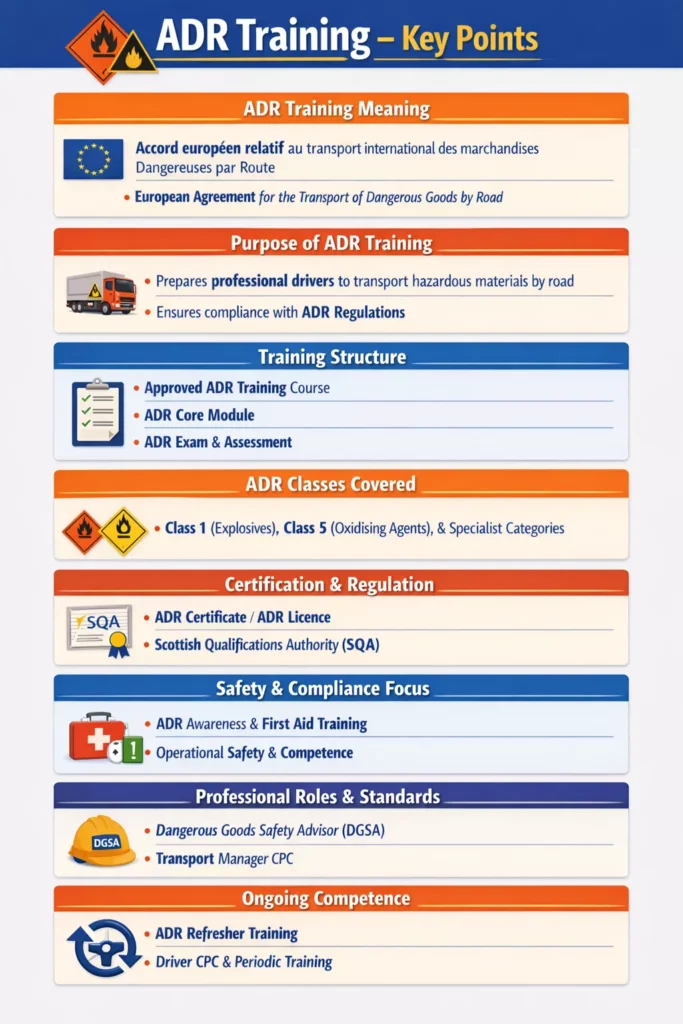
ADR Training stands for Accord européen relatif au transport international des marchandises Dangereuses par Route, formally titled the European Agreement (Accord européen relatif au transport international des marchandises Dangereuses par Route). ADR Training is a regulated form of Dangerous Goods Training that prepares a Professional Driver to transport hazardous materials by road in line with ADR Regulations. ADR Driver Training delivers structured Driver Training and Transport Training through an approved ADR Training Course, leading to an ADR Certificate and recognised ADR Certification, issued as a Vocational Training Certificate overseen in the UK by the Scottish Qualifications Authority (SQA).
The programme centres on the ADR Core Module, assessment via the ADR Exam, and subject coverage across ADR Classes, including the seven classes of dangerous goods such as ADR Explosive (Class 1), Oxidising Agents (Class 5), and other Specialist Class categories. ADR Training ensures legal compliance, operational safety, and Professional Competence by embedding ADR Awareness, Emergency Procedures, and Aid Training (First Aid), while reinforcing the roles of the Dangerous Goods Safety Advisor (DGSA) and management alignment with Transport Manager CPC standards.
Successful candidates gain an ADR Licence following Successful Completion, with competence maintained through Refresher Training and ADR Refresher Training, and professional development aligned alongside Driver CPC Training and Driver CPC Periodic Training to support safe, lawful carriage of dangerous goods across the road transport sector.

What Is ADR Training?
ADR Training is a regulated form of Dangerous Goods Training that prepares drivers and transport personnel to carry dangerous goods by road under the ADR Regulations. ADR Training delivers structured ADR Driver Training and Transport Training aligned with the European framework governing hazardous road transport. The programme leads to formal ADR Certification, issued as an ADR Certificate and recognised as a Vocational Training Certificate under UK oversight by the Scottish Qualifications Authority (SQA). Training focuses on legal compliance, risk control, and Professional Competence, verified through the ADR Exam following Successful Completion of the ADR Training Course.
The ADR Training Course covers the ADR Core Module, specialist extensions, and operational controls required for safe carriage. Course content addresses classification, packaging, labelling, vehicle equipment, documentation, load security, and Emergency Procedures, supported by ADR Awareness and Aid Training (First Aid). Governance and safety management responsibilities are reinforced through the role of the Dangerous Goods Safety Advisor (DGSA), while competency alignment supports Driver CPC Training, Driver CPC Periodic Training, and Transport Manager CPC requirements. Knowledge currency is maintained through Refresher Training and ADR Refresher Training, preserving licence validity and operational readiness.
ADR Training applies to any Professional Driver or transport professional involved in moving dangerous goods, including those seeking an ADR Licence or renewing authorisation. Coverage spans the ADR Classes, referencing the seven categories of dangerous goods, with depth across general and Specialist Class operations. Key categories include ADR Explosive (Class 1) and Oxidising Agents (Class 5), alongside the remaining ADR classifications, ensuring drivers understand hazards, controls, and incident response across all regulated substances.

Who Needs ADR Training?
ADR training is mandatory for Drivers, Operators, and Handlers and Packers involved in the road transport of dangerous goods under ADR Regulations. ADR Training applies to every Professional Driver who undertakes ADR Driver Training to obtain or renew an ADR Licence, verified through ADR Certification and issued as an ADR Certificate recognised as a Vocational Training Certificate by the Scottish Qualifications Authority (SQA). Drivers require this training to demonstrate Professional Competence across the ADR Core Module, pass the ADR Exam, and lawfully carry substances classified within the ADR Classes, including high-risk loads such as ADR Explosive (Class 1) and Oxidising Agents (Class 5), as well as each Specialist Class.
Transport Operators and management personnel responsible for planning, supervising, or authorising movements of dangerous goods also require Dangerous Goods Training. Their focus centres on compliance, risk control, and operational oversight, supported by ADR Awareness, defined Emergency Procedures, and coordination with a Dangerous Goods Safety Advisor (DGSA). Alignment with Transport Training, Transport Manager CPC, Driver CPC Training, and Driver CPC Periodic Training ensures organisational compliance across fleet operations and incident readiness, including Aid Training (First Aid) protocols.
Handlers and Packers engaged in preparation, loading, securing, and documentation of dangerous goods require ADR knowledge to apply correct classification, packaging, marking, and segregation standards. Their training links directly to the ADR Training Course outcomes, reinforcing safe handling practices and error prevention across the supply chain. Ongoing competence is maintained through Refresher Training and ADR Refresher Training, confirming Successful Completion and continued authorisation for all roles engaged in regulated dangerous goods transport.

What Does ADR Training Involve?
ADR training (Accord européen relatif au transport international des marchandises dangereuses par route) involves a structured, regulated learning process that prepares individuals for the safe and lawful transportation of hazardous goods by road. ADR training involves formal instruction, assessment, and verification of competence, leading to the award of an ADR certificate. The training focuses on legal compliance, hazard control, and operational safety across the full lifecycle of dangerous goods transport, from preparation and loading to transit and incident response.
ADR training courses cover core regulatory knowledge and applied safety practice. Core knowledge includes classification of dangerous goods, understanding hazard labels and documentation, vehicle and equipment requirements, segregation rules, and legal duties under ADR. Practical skills focus on safe loading and unloading, use of protective equipment, route planning, and implementation of emergency actions. Training places strong emphasis on recognising risks associated with substances such as radioactive matter and explosives, ensuring that candidates understand both routine handling controls and high-risk scenarios.
ADR training is delivered through defined modules that combine theory and application. Core modules establish baseline competence in ADR rules and safety principles, while additional modules address specialist areas depending on the type of goods carried. Assessment confirms understanding of regulations, decision-making under pressure, and correct response to incidents such as leaks, fire, or collision. Completion of all required modules and assessments confirms that the individual meets the standard required to transport dangerous goods safely and in full compliance with ADR.

What Is an ADR Training Certificate?
An ADR training certificate is a mandatory, 5-year legal qualification for drivers transporting hazardous goods by road across the UK and Europe. The certificate confirms successful completion of approved ADR Driver Training Certificate requirements, demonstrating that a driver meets the legal and safety standards set by ADR and enforced nationally through the Department for Transport. The ADR certificate verifies competence in the classification, handling, documentation, and carriage of dangerous goods, confirming that the holder understands regulatory duties, risk controls, and safe operating procedures.
The certificate evidences compliance with workplace and transport law, including obligations linked to Health & Safety at Work, by confirming that the driver has been assessed on hazard awareness, emergency response, and incident prevention. Validity depends on passing the required examinations and maintaining competence through periodic renewal, ensuring that certified drivers continue to operate within current ADR rules and recognised safety standards throughout the certificate period.
We offer initial and refresher ADR training covering:
-
ADR Class 1 – Explosives
-
ADR Class 2 – Gases
-
ADR Class 3 – Flammable liquids
-
ADR Class 4 – Flammable solids
-
ADR Class 5 – Oxidizing substances and organic peroxides
-
ADR Class 6 – Toxic substances
-
ADR Class 7 – Radioactives
-
ADR Class 8 – Corrosive substances
-
ADR Class 9 – Miscellaneous dangerous substances
-
Core module
-
Packages module
-
Tanker module
Our initial and refresher courses are DVSA approved for the purposes of Driver CPC Periodic Training.
ADR training can count towards 28 hours (max) Driver CPC Periodic training.
Refresher / Renewal ADR training must be taken 6 to 8 weeks before ADR expires.
How Long Does ADR Training Last?
ADR training lasts between 3 and 5 days, depending on the scope of qualification required. The duration varies according to whether a driver completes the ADR Core Module only or adds specialist modules covering specific categories of dangerous goods.
Initial ADR training includes classroom-based learning and formal examinations, with time allocated to regulatory knowledge, safety responsibilities, and emergency response.
A standard initial course usually takes 5 days when covering the core syllabus plus one or more specialist areas, such as tank transport or high-risk substances. Drivers renewing an existing qualification complete ADR refresher training, which typically lasts 2 days, provided the training is taken before certificate expiry. Training length directly reflects the level of responsibility and risk involved in the transportation of hazardous goods, ensuring drivers meet legal competence requirements before certification or renewal.
How Much Does ADR Training Cost?
ADR training costs in the UK typically range from £300 to £800, depending on the level of qualification and the modules included. The price varies based on whether the course covers only the core syllabus or includes specialist modules for higher-risk goods, tank transport, or additional classifications. Initial training costs sit at the higher end of the range because they include full instruction and examinations.
ADR refresher training costs less, usually £200 to £350, as it focuses on updating knowledge and re-assessment before certificate expiry. Fees generally include tuition, course materials, examinations, and certification, though some providers price exams separately. Overall cost reflects course duration, module selection, and assessment requirements needed to meet legal standards for transporting hazardous goods by road.
ADR Training Price Special Offer:
[Price includes VAT, Exam fee, Course Manual and Light Refreshment (Tea, Coffee and Biscuits)]
- Core, Packages, Tanks and UN 7 Classes (2, 3, 4, 5, 6, 8 & 9) – £495.00 (weekend – £695.00)
- Core, Packages and UN 7 Classes of 2, 3, 4, 5, 6, 8 & 9 – £395.00 (weekend £595.00)
- Core, Packages, Tanks and One Class – £425.00 (weekend £565.00)
- Core, Tanks and Class 2/3 (Flammable Gas/Liquid) – £ 395.00 (weekend £495.00)
- Tanks Add-On Course – £ 175.00 (weekend £295)
- Class 1 and 7 (Explosives & Radioactive) – Contact us for the date and Price.
- Dangerous Goods Awareness – £90.00
- Limited Quantities in Packages – £60.00
- Security of Dangerous Goods – £72.00 (staff), £108.00 (supervisor/manager)
Adding Driver CPC hours (upload) for only £21.00 per 7 hours, max 28 hours/4 days].
The post ADR Training: Meaning, Who Needs It, What It Involves, Duration and Cost appeared first on HCPC Training.
Key Features of ADR Online Training: Simulations, Access Time & Flexibility
Does ADR Online Training Include Interactive Hazard Simulations?
Yes, many modern ADR courses online now incorporate interactive hazard simulations as part of their learning framework, particularly in the theory modules of the ADR training online curriculum. These simulations are designed to improve hazard awareness and decision-making in a virtual setting, helping drivers gain practical insights into the risks associated with transporting dangerous goods, without the need for physical interaction.
During an ADR course online, learners may encounter realistic, scenario-based simulations embedded within the course platform. These interactive exercises allow drivers to engage with visual and situational training, such as identifying hazard labels, responding to mock emergency situations, or following correct documentation and containment procedures.
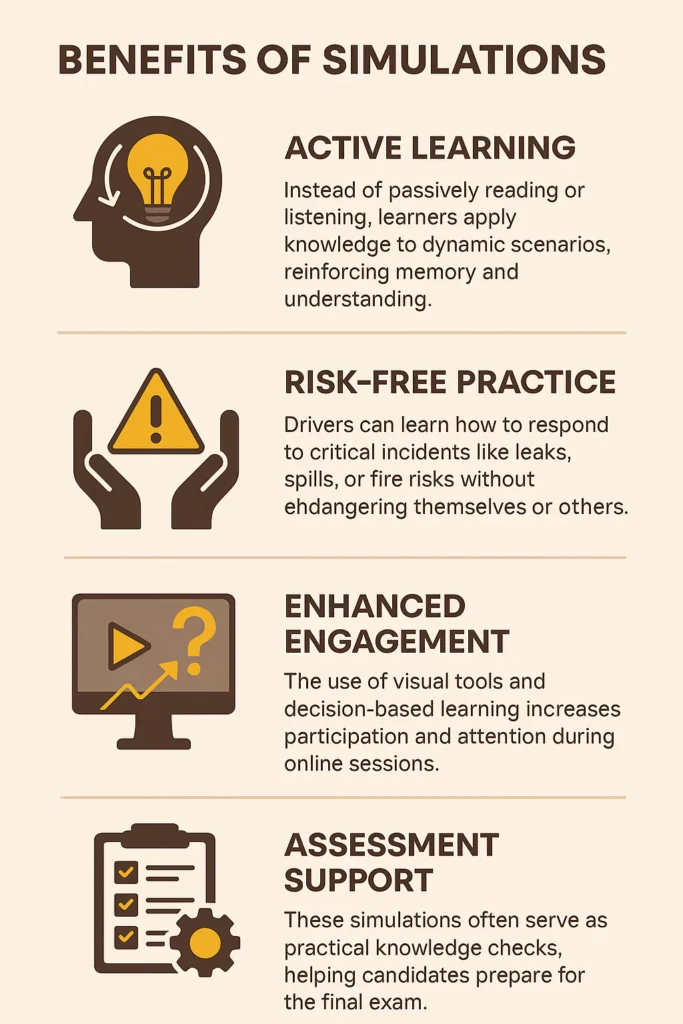
Benefits of Interactive Hazard Simulations in ADR Online Training:
- Active Learning: Instead of passively reading or listening, learners apply knowledge to dynamic scenarios, reinforcing memory and understanding.
- Risk-Free Practice: Drivers can learn how to respond to critical incidents like leaks, spills, or fire risks without endangering themselves or others.
- Enhanced Engagement: The use of visual tools and decision-based learning increases participation and attention during online sessions.
- Assessment Support: These simulations often serve as practical knowledge checks, helping candidates prepare for the final exam.
While ADR training online cannot fully replicate physical handling, these digital tools significantly improve the effectiveness of remote instruction. They’re especially useful in core and class-specific modules where understanding hazard control and safe transport procedures is critical.
How Long Do I Have Access to Course Materials in ADR Online Training?
When you enrol in an ADR course online, one of the key benefits is on-demand access to learning materials. However, the duration of access to these resources can vary depending on the provider and the format of the course. Most ADR courses online allow learners to access materials for a set period, typically ranging from a few weeks to several months, depending on the course length and examination schedule.
With ADR training online, the materials are usually hosted on a secure learning management system (LMS). This system gives students round-the-clock access to essential content such as video lectures, downloadable handouts, hazard class overviews, mock assessments, and revision guides. These resources support learners as they prepare for both theoretical and practical elements of the ADR qualification.
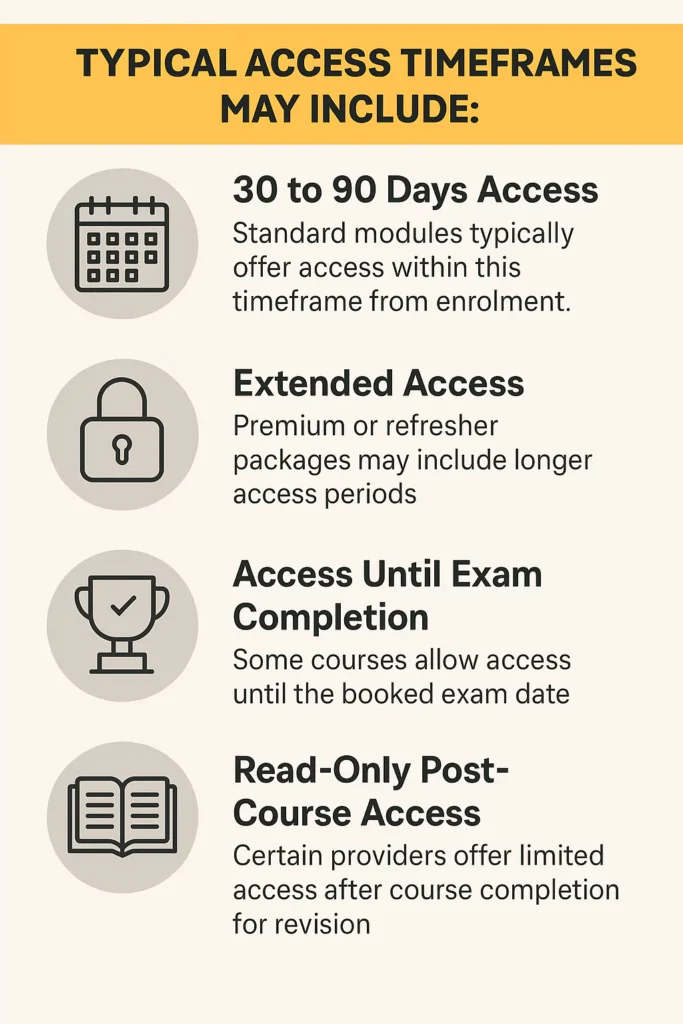
Typical Access Timeframes May Include:
- 30 to 90 days from the date of enrolment for standard modules
- Extended access for premium packages or refresher courses
- Access until exam completion, in some cases linked to exam booking dates
- Read-only post-course access, offered by certain providers for revision
Before enrolling in any ADR training online, it’s important to check the provider’s terms regarding access to digital materials. Some may include limited-time access, while others may offer extended availability for additional fees.
Having continued access to course materials allows candidates to revise at their own pace and return to complex topics before assessments. This flexibility is one of the reasons why an ADR course online is a practical choice for working professionals and first-time applicants alike.
Can I Pause and Resume ADR Online Training at Any Time?
Yes, in most cases, learners can pause and resume their ADR course online at any time, provided it’s within the course’s access period. This is a key feature of many modern ADR training online platforms, offering drivers a self-paced learning environment that aligns with busy schedules, shift work, or other personal commitments.
Providers offering ADR courses online typically use digital platforms that store your progress securely. This means you can log in, complete a section, and return later without losing your place. Whether you’re working through the core syllabus or reviewing class-specific modules, the system will track and save your position automatically.
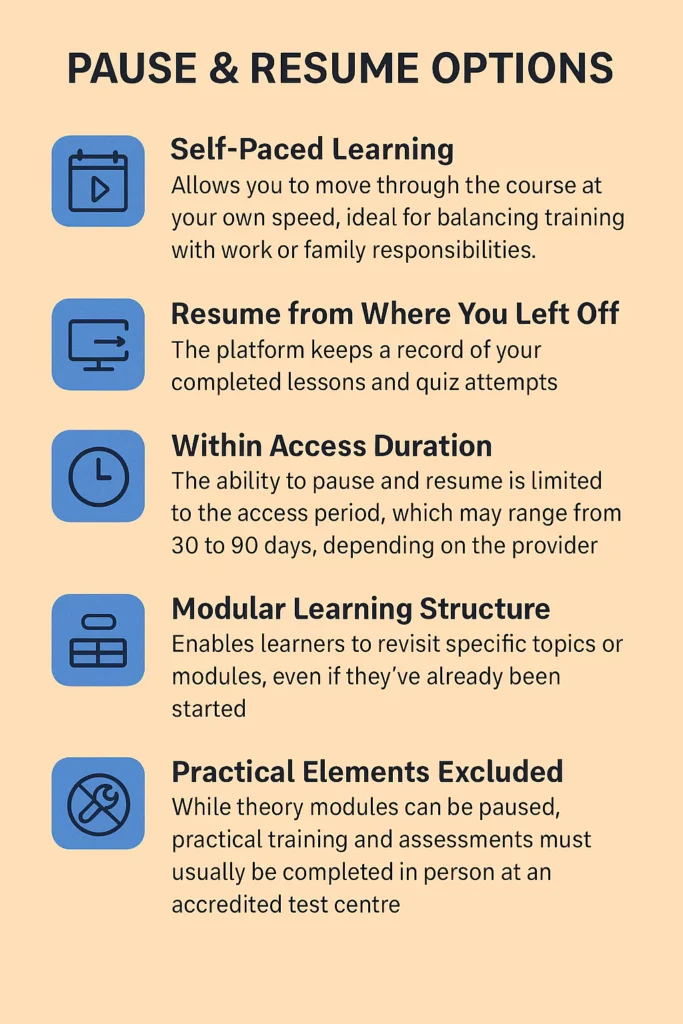
Key Aspects of Pausing and Resuming ADR Online Training:
- Self-paced learning: Allows you to move through the course at your own speed, ideal for balancing training with work or family responsibilities.
- Resume from where you left off: The platform keeps a record of your completed lessons and quiz attempts.
- Within access duration: The ability to pause and resume is limited to the access period, which may range from 30 to 90 days, depending on the provider.
- Modular learning structure: Enables learners to revisit specific topics or modules, even if they’ve already been started.
- Practical elements excluded: While theory modules can be paused, practical training and assessments must usually be completed in person at an accredited test centre.
This built-in flexibility is one of the key reasons many drivers opt for ADR training online Courses, as it provides greater control over how and when learning takes place, without compromising compliance or qualification standards.
The post Key Features of ADR Online Training: Simulations, Access Time & Flexibility appeared first on HCPC Training.
Online ADR Training: Accredited Providers, Practical Assessments & Cost Insights
Which Providers Offer Accredited ADR Courses Online?
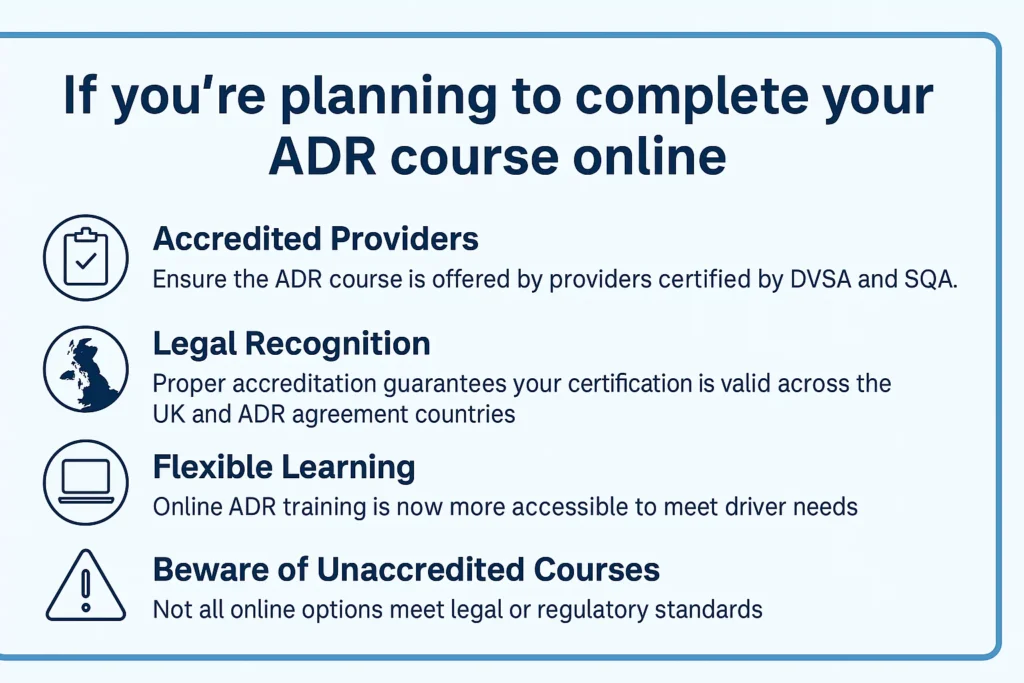
If you’re planning to complete your ADR course online, it’s important to ensure the training provider is officially accredited by the DVSA (Driver and Vehicle Standards Agency) and the Scottish Qualifications Authority (SQA). This guarantees that your ADR certification will be legally recognised across the UK and other ADR agreement countries. With more drivers looking for flexible options, ADR training online has become increasingly accessible, but not all courses meet the required standards.
How Do Online ADR Courses Handle Practical Assessments?
Although an ADR course online offers convenience and flexibility, practical assessments still play a critical role in ensuring compliance with ADR regulations. Practical elements ensure drivers understand how to handle and respond to real-world risks when transporting dangerous goods by road. These assessments cannot be completed entirely online, but ADR online training providers have adapted to blend digital learning with controlled in-person evaluations.
In most ADR training online programmes, the core theory modules, covering subjects like legislation, hazard identification, packaging codes, and documentation, are delivered via live virtual classrooms or interactive learning portals. However, the practical assessment phase, including the final exam, is conducted at an SQA-approved examination centre. This helps validate the driver’s understanding in a supervised, compliant setting.
How Practical Components Are Handled:
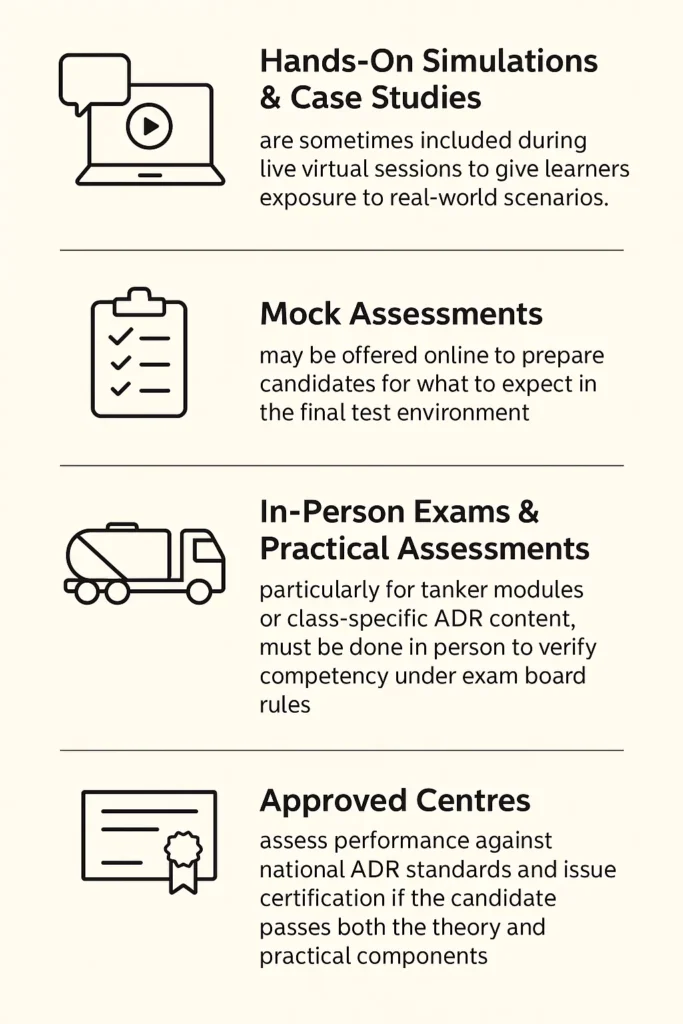
- Hands-on simulations and case study discussions are sometimes included during live virtual sessions to give learners exposure to real-world scenarios.
- Mock assessments may be offered online to prepare candidates for what to expect in the final test environment.
- Exams and physical assessments, particularly for tanker modules or class-specific ADR content, must be done in person to verify competency under exam board rules.
- Approved centres assess performance against national ADR standards and issue certification if the candidate passes both the theory and practical components.
This hybrid model ensures that while ADR courses online reduce classroom time, they still uphold the practical safety training needed for qualified ADR drivers to handle hazardous materials responsibly.
Are Online ADR Courses Cheaper Than Classroom Options?
Yes, in many cases, an ADR course online can be more affordable than traditional classroom-based training. One of the main reasons for this is the reduction in operational costs. ADR online training removes the need for venue hire, physical materials, and on-site instructors, which often translates to lower course fees for learners. Additionally, online candidates avoid travel, accommodation, and time-off expenses, making this format more cost-effective overall.
However, the price difference between ADR training online and classroom delivery is not always guaranteed. Some online courses, particularly those provided by highly reputable or specialised providers, may have pricing that matches or even exceeds face-to-face options. This is usually due to added features such as interactive learning tools, tutor support, or comprehensive digital resources.
Key Factors That Influence Cost:
- Lower Overheads: Online courses generally cost less to deliver, often resulting in reduced fees.
- Location Savings: No travel or accommodation costs for learners.
- Flexible Schedules: Study at your own pace, reducing the need to take time off work.
- Provider Quality: Accredited providers or those offering enhanced features may charge more.
- Course Scope: Longer, class-specific, or tanker modules may have higher costs regardless of format.
Things to Consider Before Choosing:
- Compare course details and inclusions across different providers.
- Assess your learning style. Do you prefer guided classroom interaction or self-paced virtual learning?
- Consider your budget and location. Online may be more viable if you’re geographically distant or managing costs closely.
In short, ADR online training Courses often provides a cost advantage, but it’s important to review what each course includes to ensure value for money and recognised certification.


The post Online ADR Training: Accredited Providers, Practical Assessments & Cost Insights appeared first on HCPC Training.